

Research
Steve Feldstein, Shreya Joshi
{
  "authors": [
    "Steve Feldstein"
  ],
  "type": "commentary",
  "blog": "Emissary",
  "centerAffiliationAll": "dc",
  "centers": [
    "Carnegie Endowment for International Peace"
  ],
  "englishNewsletterAll": "democracy",
  "nonEnglishNewsletterAll": "",
  "programAffiliation": "DCG",
  "programs": [
    "Democracy, Conflict, and Governance"
  ],
  "regions": [
    "Iran",
    "United States"
  ],
  "topics": [
    "Technology",
    "Military",
    "Security"
  ]
}
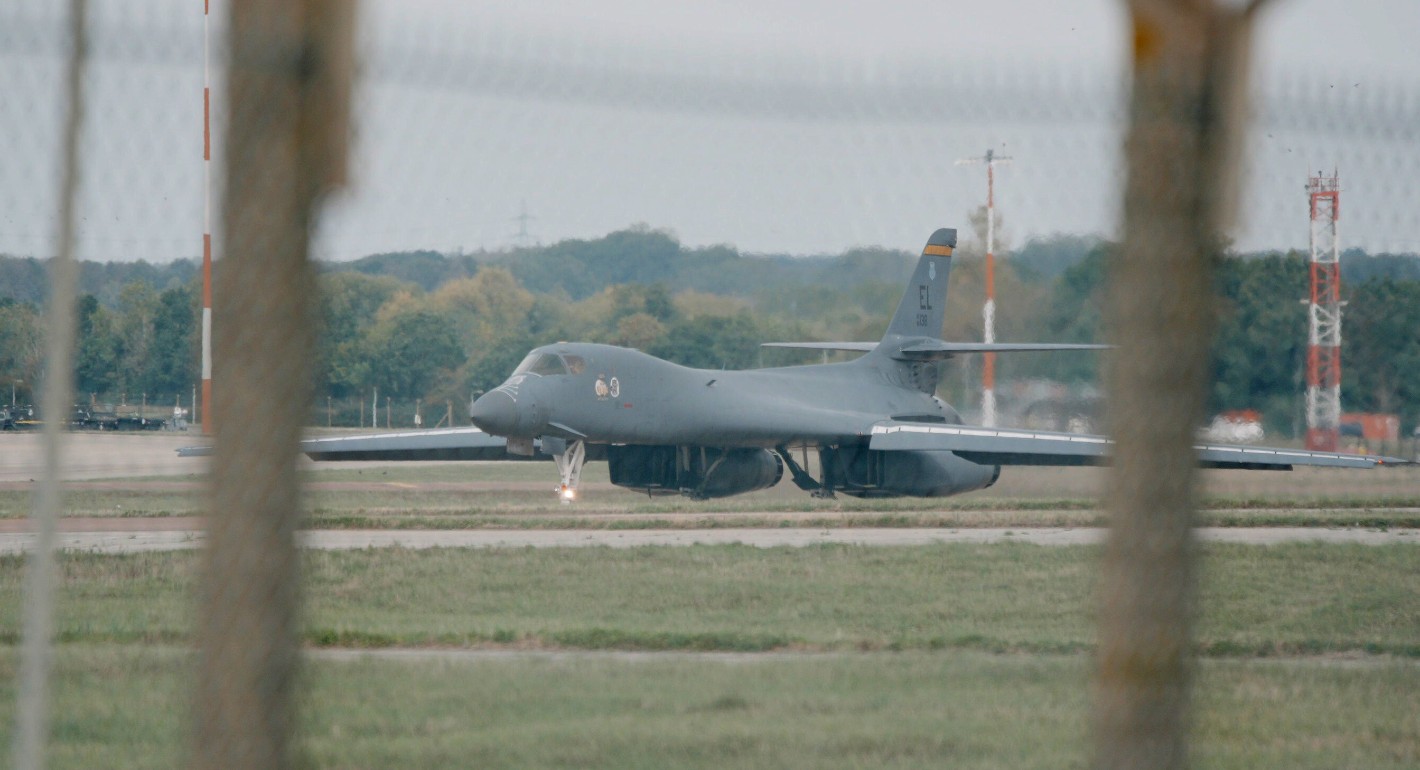
A U.S. B-1 Lancer bomber at RAF Fairford on September 29, 2026. (Photo by Ben Birchall/PA Images via Getty Images)
It signals a new era of tech diffusion and warfare.
Since March, the United States had stationed a dozen B-1 Lancer long-range bombers at RAF Fairford in southern England to support its air war against Iran. These aircraft are especially valuable because they can fly at supersonic speeds while carrying massive payloads of guided and unguided weapons. The bombers that were stationed at Fairford are worth an estimated $3.8 billion and account for one-quarter of Washington’s B-1 arsenal.
Over the weekend of October 3, military commanders abruptly evacuated the entire B-1 fleet from Fairford amid fears of an imminent Iranian attack. The removal order was so sudden that the Pentagon reportedly lacked aerial refueling planes for the bombers even as they were taking off. As one reporter described it, “It’s just like, get them out of Fairford for now, and we’ll figure out how to fuel them to get back out over the Atlantic Ocean and back to the United States.”
What had spooked the Pentagon? Sensitive intelligence suggested that Iran’s Islamic Revolutionary Guard Corps (IRGC) was planning a complex multistage drone attack against the base. Reportedly, they intended to use unmarked vans parked a quarter-mile from the fence line of Fairford to launch armed drones against the B-1s, which were sitting out in the open, as well as to target the several hundred U.S. military personnel stationed there.
The Iranian operation bore a striking resemblance to a similar effort, known as Operation Spider’s Web, carried out by Ukraine last year against Russia. Ukrainian operatives snuck in drone components to two agents in the industrial city of Chelyabinsk, approximately 900 miles east of Moscow. The agents assembled the components into 150 drones and hired unsuspecting truck drivers to transport the aircraft to locations near five different Russian air bases located thousands of miles away. At an agreed-upon time, remote operators simultaneously released the drones toward their targets. The results were devastating. Reportedly, forty-one Russian planes were struck and twelve were completely destroyed, including seven Tu-95 heavy strategic bombers capable of carrying nuclear weapons. All told, Ukraine wiped out 20 percent of Russia’s operational long-range bomber fleet, worth billions of dollars, using locally produced Osa quadcopters that cost less than $1,000 each.
Ukraine wasn’t the only country undertaking such an operation. Just a few weeks after Spiderweb, Israel launched Operation Rising Lion in Iran. For months, the Mossad had clandestinely pre-positioned armed drones and explosives in regular vehicles directed against military officers, nuclear scientists, and senior IRGC officials. At the designated signal, Israel activated the weapons, unleashing them against targets who were “still in their beds, in their homes,” an Israeli official told the Washington Post. The mission was a major tactical success, leading to the deaths of Major General Mohammad Bagheri, the highest-ranking military officer in Iran; Major General Hossein Salami, head of the IRGC; and Mohammad Mehdi Tehranchi, one of Iran’s top nuclear scientists.
Given these developments, the Pentagon felt it couldn’t risk a similar Iranian attack against its B-1 bombers. U.S. officials recognize, but won’t acknowledge publicly, that America faces growing vulnerabilities from smaller, more nimble foes. What accounts for this shift, and what are the implications?
The explanation is simple: Military innovations are spreading more quickly than ever before. Organizations can now access knowledge and expertise in rapid fashion. They can download drone designs from the web or use an AI model to generate tailored blueprints and then feed those plans into a 3D printer to produce customized weapons. The result is that a wide range of actors increasingly have the means to challenge the dominance of major powers.
Military diffusion isn’t a new concept. As I describe in my book, Bytes and Bullets, it is rooted in history and has shaped how nations have risen or fallen through the centuries. From King Henry V’s use of the English longbow to defeat the French nobility at the Battle of Agincourt in 1415 to the Japanese Navy’s deployment in 1905 of fast battleships equipped with heavy guns that vanquished Russia’s Baltic Fleet, empires and nation-states accrue short-lived advantages from new technologies, only to see their edge erode as rivals study their techniques and close the gaps.
In practical terms, diffusion is a process of innovation, emulation, and adaptation that begins when a major innovation, such as drones, reaches a critical stage and gains recognition among a broader community. This initiates a three-part cycle. Diffusion starts gradually as early adopters put the innovation to use. In 2010, just a handful of countries—including the United Kingdom, United States, and Israel—were regularly using armed drones in their military operations. Over time, adoption spreads and reaches critical mass as more actors implement the innovation. By 2019, countries such as Iran and Türkiye had mastered the drone production process and were proliferating inexpensive models, from Turkish TB2s used by Azerbaijan against Armenian forces to Iranian Shaheds deployed by Houthi insurgents against Saudi Aramco oil facilities. In the third stage, lagging actors or late adopters also take up the innovation. As the innovation spreads, adopters modify it to fit their needs and circumstances. Adaptations from the Russia-Ukraine war exemplify the third phase. When Russian forces invaded Ukraine in 2022, Ukraine barely had a drone industry. In the first months, it largely relied on military imports from the United States, Türkiye, and other states to sustain the fight against Moscow’s forces. Soon, it began developing a drone-manufacturing base. Ukrainian engineers modified consumer-grade quadcopters and battle-tested new designs, such as first-person-view drones, fiber-optic unmanned aircraft, and even long-range strike aircraft. Over time, their adaptations not only allowed them to hold firm against Russia’s assaults but also inspired emulation across the globe, from Myanmar to Mali.
Today, the process of innovation and adaptation has accelerated, with many actors able to harness powerful tech capabilities in a condensed time frame. They can use 3D printing to create “instant supply chains” to fabricate electronics components, drones, and even munitions. (Reportedly, the U.S. Army used 3D printing to produce its new BRAKER warhead, a bunker buster bomb attached to a one-way attack drone.) Frontier AI models are another catalyst of proliferation. Anthropic’s September 2026 threat intelligence report, for example, revealed how a Houthi engineering cell used Claude Code to develop multistage ballistic missiles and guided rockets, eventually test-firing a precision missile. (Apparently the test failed—and the group went back to Claude Code to figure out why.) Meanwhile in Mali, a single individual working for the national security authority used Claude to build a “mass-interception platform” that could surveil communications from all of the country’s mobile operators and generate a list of targets. What once required a team of engineers to design and build (often only with help from countries like China) can now be implemented by a lone consultant experimenting with an AI model.
Diffusion increasingly operates under a decentralized logic. Historically, experts assumed that technological innovation followed a top-down progression: Innovations were first developed in advanced economies and then spread to the periphery. Less developed states were said to benefit from being latecomers, which allowed them to free-ride on advanced innovations. Yet an emerging body of research challenges the claim that innovations largely flow from the technological leaders to others. On the contrary, less advanced states and even nonstate actors have developed ecosystems of innovation that have allowed certain groups, such as Hezbollah or the Houthis, to attain “capability tipping points,” where, according to analyst Peter Salisbury, their “internal knowledge, networks, and supply-chain access” coalesce into systems that give these organizations extended staying power and the means to contest larger powers.
Where does this leave the B-1 bomber incident? It signifies ebbing American influence and increasing uncertainty in the international arena, where challengers like Iran or the Houthis will be further emboldened to attack civilian and military targets. Ken McCallum, the director general of the UK’s domestic intelligence agency MI5, warns that “the intensity and scale and shape” of these threats are “shifting at the moment.” In the new era of tech diffusion, it is no longer unusual for Houthi militants to employ Claude to design drones and rockets, or for Iran to threaten American B-1 bombers housed deep in the English countryside, or for Hezbollah fighters in southern Lebanon to use fiber-optic drones, forged on Ukraine’s battlefields, to strike at Israeli soldiers. The world can expect more conflict, heightened rivalry, and mounting costs increasingly beyond the control of the United States and its allies.
For U.S. policymakers, these dynamics merit hard conversations. As the strategic landscape shifts, can the United States adapt? So far, the answer is discouraging. The United States remains wedded to high-cost, exquisite platforms that bring decreased utility in the new age of diffusion. President Donald Trump’s proposal for a “Golden Dome” missile defense system, whose costs could exceed $500 billion, and his push for a “Trump-class” nuclear-powered battleship—a multibillion-dollar platform considered obsolete—are baffling. The Pentagon would be better served by investing its resources in becoming a more adaptive and experimental organization better able to confront the threats arising from emerging powers and decentralized proxy groups. Other countries are pivoting accordingly; one of the core lessons from the Iran war was that low-cost, attritable counter-drone systems, like those developed in Ukraine, were far better at deterring Iranian drone strikes and protecting critical infrastructure than more expensive U.S. systems. The global environment is undergoing a major transformation, and the United States will pay a heavy price if it doesn’t change in response.

Director and Senior Fellow, Democracy, Conflict, and Governance Program
Steve Feldstein is a senior fellow and director of the Democracy, Conflict, and Governance Program at the Carnegie Endowment for International Peace. His research focuses on technology, national security, the global context for democracy, and U.S. foreign policy. His new book, Bytes and Bullets: Global Rivalry, Private Tech, and the New Shape of Modern Warfare, is now available from St. Martin’s Press.
Recent Work
Steve Feldstein, Shreya Joshi
Steve Feldstein
Carnegie does not take institutional positions on public policy issues; the views represented herein are those of the author(s) and do not necessarily reflect the views of Carnegie, its staff, or its trustees.

The conflict has sent economic and political shock waves through a country with no representation at the negotiating table—and Kenya is not alone.

Georgia Schaefer-Brown, Jane Munga

The targeting of Damietta Port appears to be more than a mere security message.

Amr Hamzawy
Despite the agreement’s uncertainty, it’s still a significant development in regional and nuclear policy.


Andrew Leber, Jane Darby Menton

By burying disagreements in imprecision, the new deal risks same fate as its predecessors.

James M. Acton

The United States and Israel may have unwittingly revived the Islamic Republic’s “zombie regime.”



Suzanne Maloney, Aaron David Miller, Karim Sadjadpour