

Research
- +5
Alper Coşkun, Fatih Ceylan, Tacan İldem, …
{
  "authors": [
    "Sinan Ülgen"
  ],
  "type": "commentary",
  "blog": "Strategic Europe",
  "centerAffiliationAll": "",
  "centers": [
    "Carnegie Endowment for International Peace",
    "Carnegie Europe"
  ],
  "englishNewsletterAll": "",
  "nonEnglishNewsletterAll": "",
  "primaryCenter": "Carnegie Europe",
  "programAffiliation": "",
  "programs": [],
  "projects": [],
  "regions": [
    "United States",
    "Europe",
    "United Kingdom"
  ],
  "topics": [
    "Trade",
    "EU",
    "Foreign Policy"
  ]
}
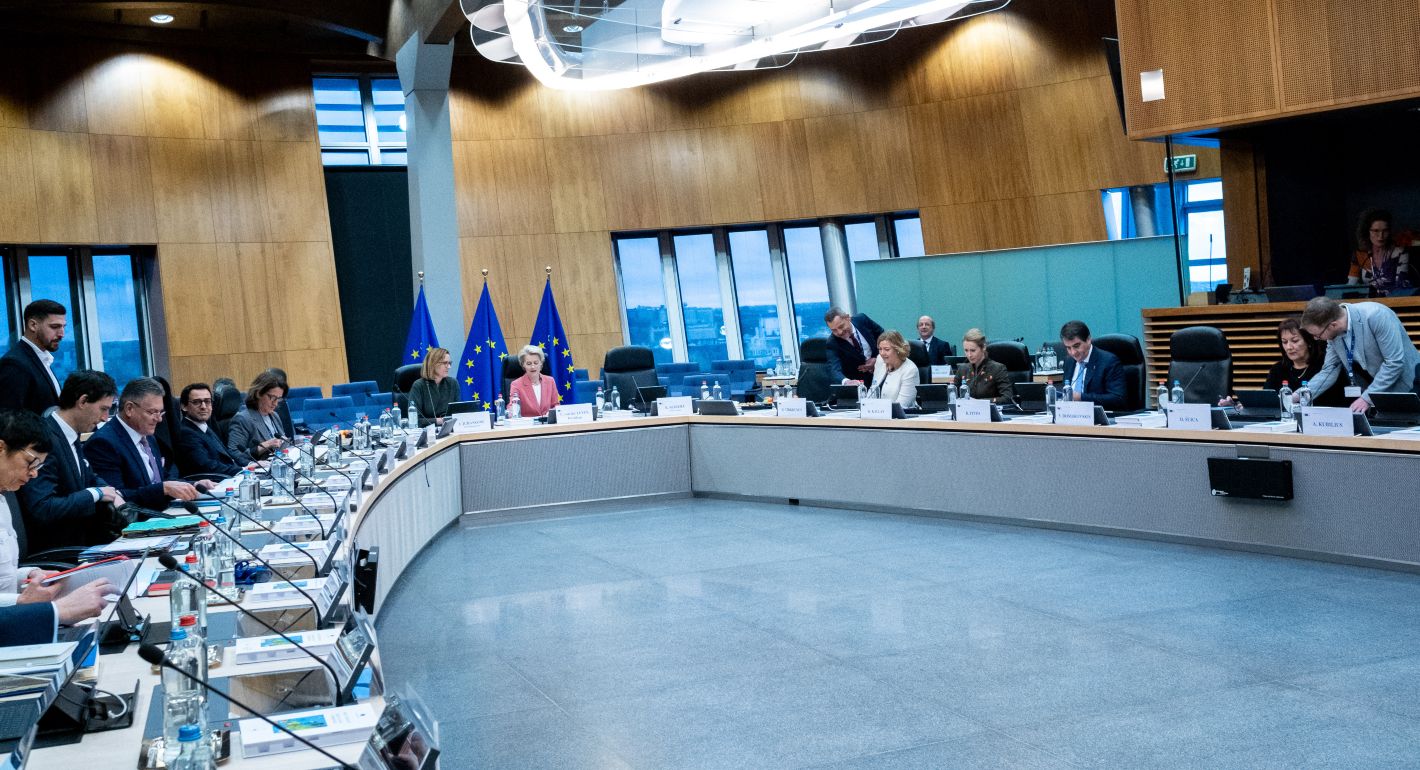
Source: Getty
The Trump administration’s decision to impose tariffs increases the likelihood of retaliatory measures and global trade wars. The response of the EU, as a major economic force, will have a significant impact on the stability of the global trading system.
Next week, the global trading system is set to experience a watershed moment. On April 2, a day U.S. President Donald Trump has called “Liberation Day” for the U.S. economy, the White House is due to unveil a slew of aggressive trade measures against allies and partner countries.
These will follow the trade investigation launched on February 21 against six countries—Austria, France, Italy, Spain, Turkey, and the UK—for their implementation of a digital services tax.
Trump’s goal seems straightforward: to shrink the United States’ $1.2 trillion deficit in global goods trade. But the reality is more complex. Not only is it economically unsound to focus exclusively on bilateral trade deficits, but the American president also seems unwilling to look at the whole of U.S. trade, including both goods and services.
The Trump administration is expected to impose additional tariffs on the targeted countries beyond the previously announced tariffs on steel and aluminum. These “reciprocal tariffs,” which are a guiding principle of Trump’s program, threaten America’s economic prosperity, with repercussions on global markets. Beyond that, they have the potential to initiate a global trade war, with several countries seeking to retaliate. This is particularly true given that the United States assesses its trading partners not only on the basis of the tariffs they impose on U.S. goods but also on the severity of their nontariff barriers, such as regulatory regimes that affect large digital companies.
The United States’ stark departure from international trade rules will affect the global trading order, given the size of the country’s economy. But the EU is not helpless in the face of this willful noncompliance by its biggest trading partner.
The reaction of the EU, as a major trading powerhouse, will have a significant bearing on the future stability of the global trading system. Three scenarios are possible for the EU.
First, it could decide to take the path of acquiescence. Under this assumption, the EU would opt to placate the U.S. president. It would not retaliate and would instead agree to reduce the tariffs and nontariff barriers identified by the White House. The underlying logic may be to prevent a trade war at a time when European economies face other serious challenges, such as the need to increase defense expenditures.
So far, this has been the UK’s preferred option when faced with American tariffs on steel and aluminum. The EU, meanwhile, has signaled its readiness to retaliate quickly. As things stand, the union is unlikely to adopt an acquiescent stance because when it comes to nontariff barriers, Brussels will not want to bow to U.S. pressure to change its regulatory norms.
Second, the EU could choose to retaliate. Under this scenario, the EU would judge that the White House’s blackmailing approach should not be condoned and that the union cannot comply with its egregious asks. Brussels could then decide to invoke its newly adopted anticoercion instrument, which is one of the EU’s policy measures designed to enhance its economic security. The underlying logic would be that despite U.S. pressure, the EU should remain committed to international trade rules and its WTO commitments. This is a more likely scenario than acquiescence.
Third, despite the unilateralism of U.S. action, the EU might still decide to engage with its main transatlantic partner with a view to reaching a settlement.
But even in this scenario, there are limits to how much the EU can engage. The union could propose to lower tariffs on a range of goods of interest to the U.S. president, starting with cars, where the EU’s common external tariff is noticeably higher than that of the United States. At present, most-favored-nation imports of cars face a 10 percent tariff in the EU, versus a 2.5 percent tariff in the United States.
The EU could also negotiate the implementation of the digital services tax. For instance, the statutory rate of 3 percent on national turnover could be reduced, or exemption thresholds could be raised. The UK seems to be heading in that direction.
This particular U.S. demand might also be deemed compatible with WTO rules. In the past, the WTO has ruled that even if applied in a nondiscriminatory manner, internal taxes could be considered to be in violation of the national treatment clause if, in practice, they disproportionately affect imports compared with domestic production.
Negotiations over digital regulation, however, are likely to be more complicated. Trump has specifically complained about the EU’s Digital Markets Act and Digital Services Act, alleging that this set of legislation was designed to hinder the market access and practices of U.S. companies. The EU will find it more difficult to satisfy Trump on this matter. It will be more crucial for Brussels to maintain its role as the pioneering regulatory power in the digital sphere, as illustrated by the impact of the General Data Protection Regulation (GDPR) and now, possibly, the AI Act.
Ultimately, the unfolding of this more cooperative scenario would depend on how EU policymakers strategize over the nature of their long-term outreach to the U.S. president. In other words, they would need to decide whether a strategy of engagement that involves negotiating away some existing EU practices is a sustainable path. Such a strategy could be perceived as a sign of appeasement, or even weakness, for a U.S. president who looks at the world in purely transactional terms.
Quite possibly, the outcome of this disagreement over trade policy will reveal the overall nature of the transatlantic relationship in the Trump era.

Senior Fellow, Carnegie Europe
Sinan Ülgen is a senior fellow at Carnegie Europe in Brussels, where his research focuses on Turkish foreign policy, transatlantic relations, international trade, economic security, and digital policy.
Recent Work

Alper Coşkun, Fatih Ceylan, Tacan İldem, …
Carnegie does not take institutional positions on public policy issues; the views represented herein are those of the author(s) and do not necessarily reflect the views of Carnegie, its staff, or its trustees.

With its public finances in shambles, the far right polling at 35 percent ahead of the 2027 presidential election, and a growing protest movement, is France’s crisis a threat to the EU’s geopolitical awakening?

Rym Momtaz, ed.

Ahead of a tough winter for Ukraine, Donald Trump’s swing back toward Russia bodes ill. But instead of panicking, Kyiv’s European allies are focusing on action.
Rym Momtaz

While the EU and European governments are embracing the much-lauded middle-power moment, this entails three difficult conundrums.

Richard Youngs
Much has been said of the changes Brussels is trying to make to the EU enlargement process. Here’s why gradual integration might—or might not—be the answer.

Dimitar Bechev

The European Commissioner for Trade is headed to China. But after President Xi’s bridge-building visit to Washington, can a more isolated EU overcome Beijing’s stranglehold on critical raw materials? Who will blink first?
Rym Momtaz, ed.