

Commentary
Tatiana Stanovaya
{
  "authors": [
    "Tatiana Stanovaya"
  ],
  "type": "commentary",
  "blog": "Carnegie Politika",
  "centerAffiliationAll": "",
  "centers": [
    "Carnegie Endowment for International Peace",
    "Carnegie Russia Eurasia Center"
  ],
  "englishNewsletterAll": "",
  "nonEnglishNewsletterAll": "",
  "primaryCenter": "Carnegie Russia Eurasia Center",
  "programAffiliation": "",
  "regions": [
    "Russia"
  ],
  "topics": [
    "Domestic Politics"
  ]
}
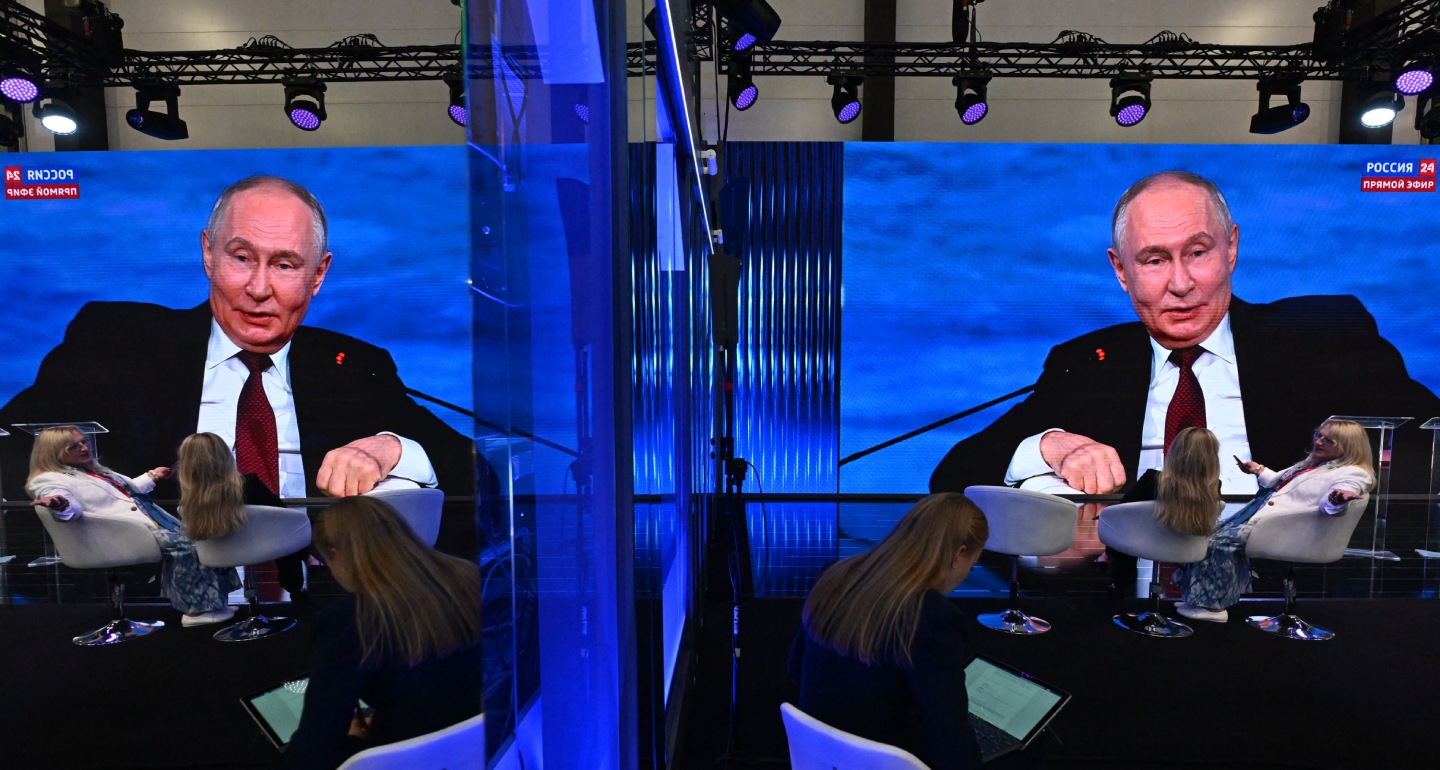
Source: Getty
The issue is not that the president only has selective information at his disposal, but that the decision-making process consists of one person with an unshakeable vision of how the world works.
After several weeks of making hardly any public comments on the Ukraine war, Russian President Vladimir Putin finally broke his silence at the St. Petersburg International Economic Forum (SPIEF) last week. There may be a growing feeling inside Russia that it is time to end the war, but Putin made it unequivocally clear that there was no chance of economic problems, stalemate at the front, or tensions at home pushing the Kremlin to soften its position on the war or make any concessions to Kyiv.
The vision outlined by Putin at the economic forum differed little from what he has been repeating for many years. The president was typically bullish on the Russian economy. Anti-inflationary measures are effective, GDP is growing along with household incomes, and in terms of GDP measured at purchasing power parity, Russia has overtaken all of Europe and is now fourth in the world. There are some difficulties, of course, but they are routine and under control.
Meanwhile, according to Putin, the world is changing fast, undergoing a major transformation that is the beginning of the end for the West and NATO, the unipolar world, and imposed double standards. All of that gives the Russian leader confidence that the war in Ukraine is his contribution to the transformation of the world order. This feeling of profound historical righteousness and messianism leaves no room for defeat or even concessions.
Nor has Putin’s attitude changed to specific aspects of the war, even though much has changed at the front in the last year. Ukraine is increasing the scale of its medium-range strikes against Russia, which has prompted talk among some military experts of Kyiv gaining the upper hand in the skies. Ukraine now carries out massive drone attacks on the overland corridor connecting Russia with Crimea, which have left the peninsula without gasoline, as well as against logistics targets in the Donbas and infrastructure in the Black Sea basin in Russia’s Krasnodar region. The attacks are so intense that Russian short-range air defense systems are running out of ammunition.
The importance and sustainability of such an advantage are open to debate, but even without it, expectations of a Ukrainian frontline collapse have dissipated, and the Russian army’s advance has all but ground to a halt. It does not look likely that Russia will be able to capture the remaining parts of the Donbas still under Ukrainian control in the foreseeable future, even though just last year, it seemed like that was only a matter of time.
None of that, however, figures in Putin’s thinking. He insists that Russia “is advancing along the entire front,” has increased its control of the Donetsk region from 75 percent to 85 percent (an exaggeration), and is confidently advancing in the Zaporizhzhia region. Putin is confident that Moscow still has significant potential for non-nuclear escalation (the Oreshnik intermediate-range ballistic missile has not yet been used in combat), while the Ukrainian army is falling apart.
In other words, Putin’s position remains unchanged: there is no alternative to what was supposedly agreed last summer when he met with U.S. President Donald Trump in Anchorage, Alaska. Ukraine must withdraw its troops from the Donbas, and only then will the war stop, making it possible to discuss a “lasting peace.” Russia doesn’t need a ceasefire, since Moscow believes that would just be used to stop Russia’s advance and buy time for Kyiv. Putin has no intention of meeting with his Ukrainian counterpart Volodymyr Zelensky, and in any case, no one in Ukraine’s corridors of power wants peace, hence the need for regime change there.
Russia is prepared to accept Europe’s participation in the peace talks as an intermediary—but only if the Europeans stick to “the framework of the Anchorage agreements.” In other words, EU capitals must start to persuade Kyiv to withdraw its troops from the Donbas.
In short, Putin is becoming more and more tangled in the “Anchorage trap.” The Kremlin is increasingly adamant it will accept nothing short of a make-believe deal that is becoming less realistic by the day.
All of this debunks the notion that Putin recognizes that the situation is becoming critical, is looking for a way out of it, and just needs a little help in doing so. In fact, the Russian president considers his situation far from critical, and genuinely believes that victory is inevitable. He is prepared to secure that victory using both military and diplomatic means—but only on Moscow’s terms.
The issue is not that the president only has selective information at his disposal, or that the security services are keeping things from him in an attempt to manipulate him. There is no doubt that Putin is calling the shots. The issue is that the decision-making process consists of one person with an unshakeable vision of how the world works. That vision filters out anyone who might think otherwise and any information that contradicts it, while narratives that appear to back up that vision are seized upon and circulated infinitely.
In this worldview, the West is decaying, the United States is losing its hegemony, Ukraine is falling apart, its army is disintegrating, Europe is in chaos, Russia is advancing along the entire front, victory is inevitable, the economy can cope with all the challenges thrown at it, and the Russian people will support their rulers. Accordingly, no concessions should be expected from Putin, no matter how bad the situation gets. The Russian president is certain there will always be enough resources for his war, and if patience wears thin, then that will lead not to a softening of his position, but to a new round of escalation.

Senior Fellow, Carnegie Russia Eurasia Center
Tatiana Stanovaya is a senior fellow at the Carnegie Russia Eurasia Center.
Recent Work
Tatiana Stanovaya
Tatiana Stanovaya
Carnegie does not take institutional positions on public policy issues; the views represented herein are those of the author(s) and do not necessarily reflect the views of Carnegie, its staff, or its trustees.

Ex-president Gurbanguly Berdimuhamedov remains interested in politics, but his son Serdar, Turkmenistan’s current president, is becoming increasingly independent and willing to break with his father’s legacy. If their covert rivalry goes too far, both risk losing power.

Galiya Ibragimova

For every ruble allocated to social policy, health, and education in 2027, double that amount is earmarked for the army, the police, and the security services.

Alexandra Prokopenko
An analysis of traffic accident data suggests that Ukrainian drone attacks caused a material but not disastrous fall in Russian gasoline consumption over the summer.

Sergey Vakulenko

Sergei Kiriyenko used Russia’s parliamentary vote to further hone his strategy of corporate mobilization that is designed to maximize votes for United Russia.

Andrey Pertsev

If the Russian-speaking community in Latvia cannot articulate their interests without being seen as disloyal, they could end up embracing a pro-Kremlin agenda.

Sergejs Potapkins