

Commentary
Alexander Baunov
{
  "authors": [
    "Alexander Baunov"
  ],
  "type": "commentary",
  "blog": "Carnegie Politika",
  "centerAffiliationAll": "",
  "centers": [
    "Carnegie Endowment for International Peace",
    "Carnegie Russia Eurasia Center"
  ],
  "englishNewsletterAll": "",
  "nonEnglishNewsletterAll": "",
  "primaryCenter": "Carnegie Russia Eurasia Center",
  "programAffiliation": "",
  "regions": [
    "Russia"
  ],
  "topics": [
    "Domestic Politics"
  ]
}
Source: Getty
Blurring the line between humans and animals is a long-standing tradition in social utopian prose. In his latest novel, Leonid Bershidsky reminds us that in social experiments, people are often treated no differently than animals.
One of the three plotlines of Leonid Bershidsky’s new book Animal Tested unfolds in an imaginary Germany where the authorities are using digital tools to monitor average levels of happiness. It quickly becomes clear that average figures do not necessarily translate into individual happiness. There are no pet dogs, for example, without which some people cannot be happy. The lack of dogs becomes the starting point for a rebellion against an expertocracy in which everyone is missing something: a dog, a beer hall, or even the good old Bundestag.
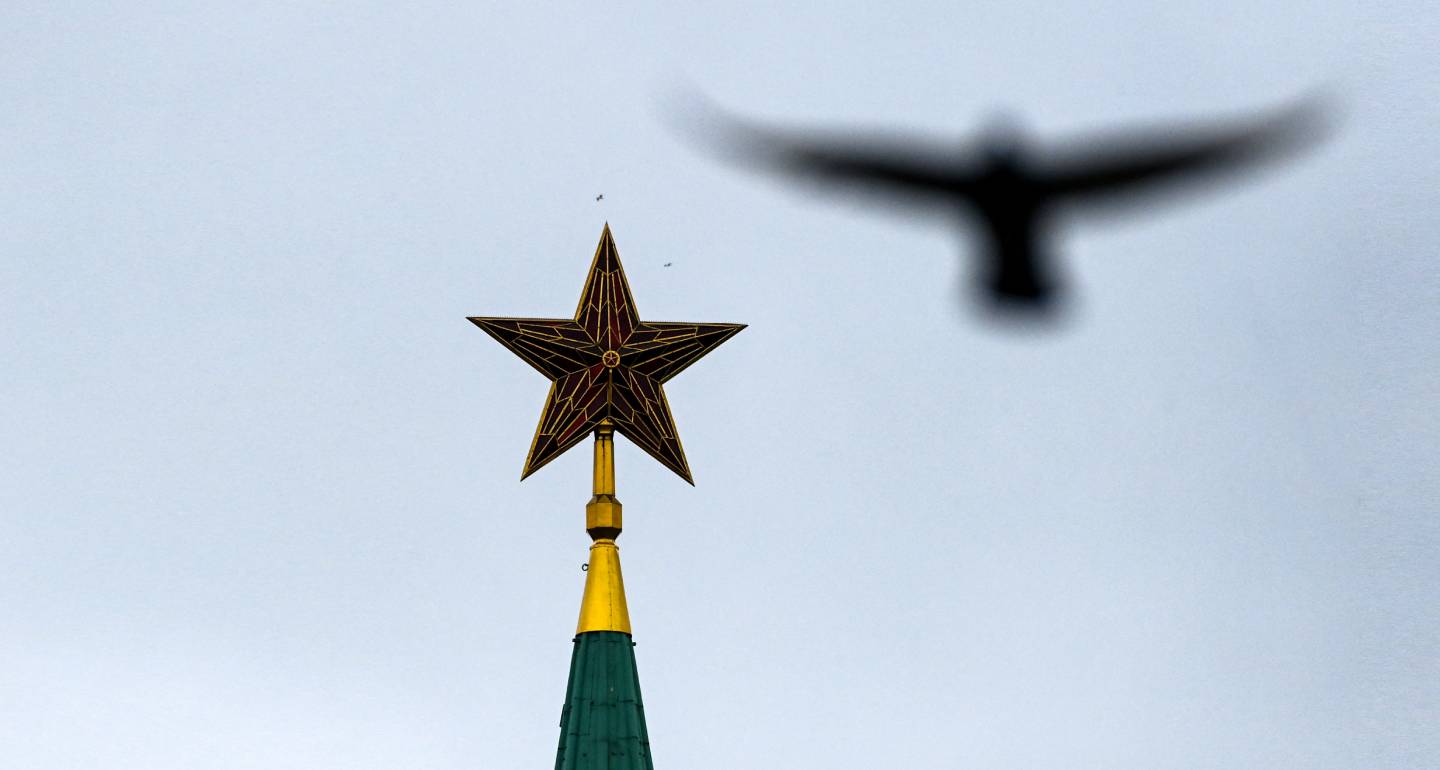
In a different imaginary world—one that is unmistakably Russian—the rebellion is sparked by crows. Indeed, the masterfully crafted opening pages of Animal Tested begin with black crows soaring over the golden domes of the Kremlin.
The Berlin-based Bershidsky is a legendary journalist who set up several Russian publications in the early 2000s that were crucial in shaping the media landscape, both then and now. After working as a commentator for Bloomberg news agency, he disappeared from public life for five years. With his latest novel, Bershidsky has completed the transformation to which most journalists eventually aspire: from describing the world to creating whole new worlds.
There are three constellations in Bershidsky’s celestial map: dogs, rats, and crows. The story itself unfolds like a social media feed filled with videos, or a series of Instagram posts: First we see crows gliding over a golden cupola, then—with a swipe of a finger—we are looking at Asian scientists experimenting with rats behaving in amusing ways. Swipe again and we see a litter of Chihuahua puppies in a Thuringian village.
Such shifting imagery is more familiar to modern readers than the slow, steady progression of a single plotline. Even readers with extremely short attention spans will not have a chance to get bored: First we go back to the crows, then check in on the dogs, then see what the rats have been up to in the meantime. With each “video clip” interrupted at its most interesting point, suspense builds steadily through the whole book.
In one sense, each of Bershidsky’s three plotlines is a fairy tale with a happy ending. But these endings are all different. In one, power is seized by the good old guard; in another, good new forces take over (though many see them as evil); and in the third, a dictator wins a battle for power and his life story becomes a success (if success can be understood as the somewhat feverish and hallucinatory, perhaps even posthumous, merging of the dictator’s body with the psyche and body of a crow).
The crow is a good contender for the title of the most quintessentially Russian bird. Just try to take a photo of Orthodox cupolas in Russia without capturing a crow in the frame. Like most Russian people, the crow is a master of survival. It’s the ultimate avian pleb. If, in Bershidsky’s world, a sports coach from the suburbs can become the ruler of Russia, then—at least at an ornithological level—the crow is also an ideal candidate for a position of high power.
Animal Tested shows Europe becoming a victim of its own humanity. If individuals are valued above all else, it argues, then dogs can be sacrificed for the greater good—just like tobacco and alcohol before them. Later, the sacrifices will be freedom of movement, the right to live in your own house, and the right not to wear a surgical mask. Bershidsky’s vision of a crisis for German civilization draws on the coronavirus pandemic, when politicians relied on experts to tell them what to do.
While the author clearly loathes collective action like the coronavirus restrictions, the monster of expertocracy that he invokes is not immortal, or without its sensitivities. Herein lies the book’s honesty.
For decades now, we have been hearing that a liberal dictatorship would be more terrifying than the classic dictatorships of the past. But this prophecy never comes true, while the traditional tyranny of men with guns, batons, handcuffs, and the paddy wagon is as omnipresent as it ever was.
Even the Covid pandemic–era measures, which shook the world and the author to their core, did not evolve into a global rule of QR codes, and did not become permanent. The governments of free countries and cities did not cling on to the instrument of complete control that scientists had obligingly offered them. On the contrary, they were quick to repeal the measures as soon as the pandemic and fear it had caused subsided. Outside Russia’s Supreme Court building, however, anti-Covid measures remain in place, just as they do around government buildings in Baku, Azerbaijan. It’s the same story in Turkmenistan and North Korea.
Animals play a central role in Bershidsky’s novel. In the end, it is dogs who help Europe escape its digital concentration camp, and it is rats who usher joyful, rebellious young people into the White House. In other words, rats and dogs have swapped roles: While dogs seek out the good old world, rats help get rid of Washington’s ossified political establishment. A biologist working for a pharmaceutical corporation finds herself the reluctant leader of the revolution in the United States after she discovers something about the animals being used for testing.
Blurring the line between humans and animals is a long-standing tradition in social utopian (or dystopian) prose. In this book, it serves to remind us that in social experiments, people are often treated no differently than animals. Ultimately, Bershidsky is writing about human test subjects.
All three plotlines—crows, dogs, and rats (respectively, Russia, Europe and the United States)—converge in a finale that unfolds with the simplicity of an ancient tragedy. Representatives of the three worlds, which have all suffered upheaval, make contact with one another through a screen. The sports coach in the Kremlin calls his Western partners and catches them in a moment of what he sees as unprecedented weakness. That means it’s time to act.
The mechanical nature of this connection—literally a deus ex machina—leaves the reader with a feeling of open-endedness: Only when the final page is turned will fate truly bring these worlds together. It appears that this collision will happen very soon—and it will be terrifying. Perhaps that was the reason for writing the book in the first place.

Senior Fellow, Editor-in-Chief, Carnegie Russia Eurasia Center
Baunov is a senior fellow and editor-in-chief at the Carnegie Russia Eurasia Center.
Recent Work
Alexander Baunov
Alexander Baunov
Carnegie does not take institutional positions on public policy issues; the views represented herein are those of the author(s) and do not necessarily reflect the views of Carnegie, its staff, or its trustees.

A leak of Russian gas price data helps establish that China is paying Russia far less than Central Asian countries and Gazprom’s former European customers.

Sergey Vakulenko

Japan’s long-term security policy is driven by concerns about China, and there is little appetite for (or interest in) pursuing a confrontation with Moscow.

James D.J. Brown

The truth of the strategic situation is that Europe and Russia are extremely unlikely to be able to “turn the page” on their confrontation within the next two decades.

Arkady Moshes

Russia spent years building a “sovereign internet,” concentrating web infrastructure exclusively within Russian territory. Ukrainian drone attacks have shown how vulnerable that approach has left the Russian internet.

Maria Kolomychenko

Putin’s conservative staffing policies and search for ever greater control have cemented parliament’s transformation into a bureaucratic appendage of the executive branch.

Andrey Pertsev