

Commentary
Nikita Smagin
{
  "authors": [
    "Nikita Smagin"
  ],
  "type": "commentary",
  "blog": "Carnegie Politika",
  "centerAffiliationAll": "",
  "centers": [
    "Carnegie Endowment for International Peace",
    "Carnegie Russia Eurasia Center"
  ],
  "englishNewsletterAll": "",
  "nonEnglishNewsletterAll": "",
  "primaryCenter": "Carnegie Russia Eurasia Center",
  "programAffiliation": "",
  "regions": [
    "Iran",
    "Russia"
  ],
  "topics": [
    "Trade",
    "Global Governance",
    "Foreign Policy"
  ]
}
Source: Getty
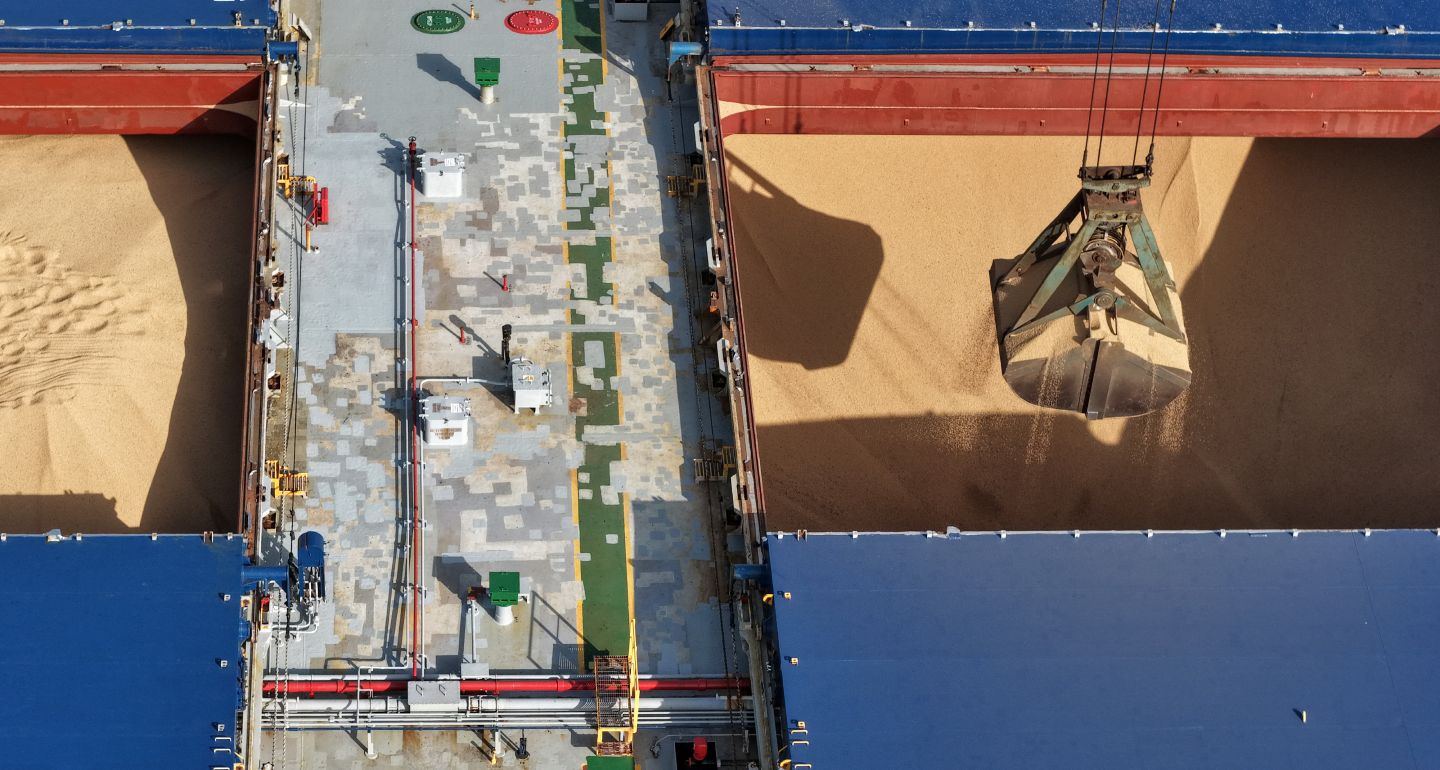
While the current surge in grain trading activity in the Caspian Sea is undeniably impressive, it is constrained by financial, infrastructure, geographic, military, and environmental factors.
The wars in Ukraine and the Middle East have thrown the international grain trade into turmoil. Russia, one of the world’s biggest grain exporters, has been deprived of its main grain export route via the Black Sea, while Iran, a major grain importer, has had to halt the operations of its ports in the Gulf. As a result, increasing grain shipments across the Caspian Sea is now a priority for both countries.
The maritime blockade of Iran imposed by the United States has led to an almost total shutdown of Iranian ports on the country’s southern coast, which handled more than 80 percent of Iranian imports before the current war. Accordingly, Tehran is urgently seeking alternative supply routes, particularly for critically important goods like food.
In addition to existing routes via Türkiye and Iraq, Tehran is trying to establish overland supply corridors from China and Pakistan. But land-based routes suffer from poorly developed infrastructure, high costs, and limited capacity—and will not be enough to fill the gap.
The only maritime alternative is the Caspian Sea—and Russia. The world’s number one exporter of wheat, Russia is also in the top five when it comes to barley and corn. In addition, Ukraine’s military successes have led to almost a complete halt to grain shipments from Russia’s Black Sea ports and forced Moscow to seek alternative routes.
The situation has led to a revival of the largely forgotten idea of establishing a Russian grain hub in Iran to supply countries like Iraq, Afghanistan, and Pakistan. This was promoted by Russia in 2023 and 2024—and circumstances are once again propelling Moscow to look seriously at the idea.
The reorientation of Russia–Iran trade to the Caspian Sea is already under way. Moscow has been transferring vessels from the Volga River and the Sea of Azov, and in August 2026 the number of Iranian- and Russian-flagged ships in the Caspian Sea was 21 percent higher than a year earlier. The two nations currently have about 200 vessels in the area.
Cargo throughput is growing rapidly at all Russia’s Caspian ports. Between January and August 2026, cargo turnover at the ports of Astrakhan and Olya increased 72 percent, hitting 4.9 million metric tons. A record amount of 71,700 tons was shipped from the port of Makhachkala in August 2026.
Iranian officials have also reported rapid increases. The head of Iran’s Gilan Province, which includes much of the country’s Caspian coast, has said that the number of containers arriving in local ports rose 50 percent between March and August 2026. Most of these containers are carrying grain.
This is not just a matter of rerouting existing cargo that once arrived in Iran via the Gulf. Between January and August 2026, Iran imported 70 percent more Russian grain than in the same period the year before, becoming Russia’s third-largest buyer as it seeks to build up food reserves.
It’s likely that even more grain would have been moved across the Caspian if more ships had been available. Freight rates for grain shipments in the Caspian region in September had more than doubled over the previous year. The reason was demand outstripping supply.
Increasing use of the Caspian Sea might appear to be a lifeline for Russian farmers. After all, grain export volumes via most of the other routes out of Russia are falling, while volumes to Iran are rising. However, that doesn’t mean it will be easy for the two countries to dramatically boost trade ties—let alone establish a Russian grain hub in Iran.
The most significant barrier is regional infrastructure. This is not only a problem of insufficient ships, but also of geographical and environmental factors. The Caspian Sea is a closed basin and getting dry-cargo vessels to its waters is not easy, with river locks and the depth of the Volga–Don Canal restricting the length, width, and draft of the ships that can be moved.
Furthermore, the rapid receding of Caspian Sea water levels makes it difficult to use the vessels that are already in place. The depth of the Volga–Caspian Canal dropped this summer from its intended level of 4.5 meters to as little as 3.2 meters, leading to congestion and the suspension of traffic in some places. In addition, in winter, ports on the Volga usually have to halt operations because of heavy ice and lower water levels.
Ensuring a steady flow of traffic through the Caspian Sea would require regular dredging operations near ports and a new fleet capable of navigating shallow waters, and not only in Russia: The port infrastructure in Iran is in even more urgent need of upgrading. And it’s doubtful whether Tehran will be able to make the required financial investments in the middle of a war and an economic crisis.
It would also be a mistake to think that there is no military risk to the Caspian Sea. Israel launched strikes on Iran’s port city of Bandar Anzali in March this year. Then, in July, Ukraine attacked Russian cargo ships sanctioned by the West in the Caspian Sea, followed in September by the port of Makhachkala.
Finally, there are financial issues. Russian grain exporters have complained privately about the debts racked up by the Iranian side. Given that Tehran has seen a major fall in oil revenues amid the war, it’s unlikely to be able to find the money either for infrastructure development or to pay in full for imports.
In these circumstances, Russian loans appear to be the only way that significant Caspian transit could become a reality. However, the war in Ukraine has also seriously impacted Russia’s finances.
Notwithstanding the optimistic rhetoric from officials, the idea of establishing a grain hub in Iran has always been fraught with difficulties. Russian investors and agricultural producers are skeptical because the funding required is too large and potential returns too uncertain. While the current surge in grain trading activity in the Caspian Sea is undeniably impressive, it’s likely to come to an abrupt end the moment the situation in the Black Sea stabilizes.

Expert on Iranian foreign and domestic policies, Islamism, and Russia's policy in the Middle East
Recent Work
Nikita Smagin
Nikita Smagin
Carnegie does not take institutional positions on public policy issues; the views represented herein are those of the author(s) and do not necessarily reflect the views of Carnegie, its staff, or its trustees.
Russia officially endorses Yemen’s formal government while quietly providing military support to the Houthi rebels. However, recent escalation in Yemen has thrust Russia’s game into the spotlight—and risks endangering its relations with the Gulf states.

Ruslan Suleymanov

The concrete goal of an end to the hostilities in Ukraine has been replaced by a host of vague Russian demands concerning a range of issues and regions.

Alexander Baunov

It’s a testing time for Russia’s policy in Serbia and the wider region, but it would be premature to conclude from one political setback that the days of Russian influence are over.

Dimitar Bechev

There are limits as to how far the shift in South Korea’s foreign policy will go.

James D.J. Brown

A gas deal would create palpable economic value, but it wouldn’t fundamentally change the position of either Russia or the EU.

Sergey Vakulenko