

Paper
Chung Min Lee
{
  "authors": [
    "Chung Min Lee"
  ],
  "type": "commentary",
  "centerAffiliationAll": "dc",
  "centers": [
    "Carnegie Endowment for International Peace"
  ],
  "collections": [
    "Korea: Emerging Player"
  ],
  "englishNewsletterAll": "asia",
  "nonEnglishNewsletterAll": "",
  "primaryCenter": "Carnegie Endowment for International Peace",
  "programAffiliation": "AP",
  "programs": [
    "Asia"
  ],
  "regions": [
    "Asia",
    "East Asia",
    "South Korea",
    "North Korea"
  ],
  "topics": [
    "Arms Control",
    "Foreign Policy",
    "Democracy",
    "Nuclear Policy"
  ]
}
Source: Getty
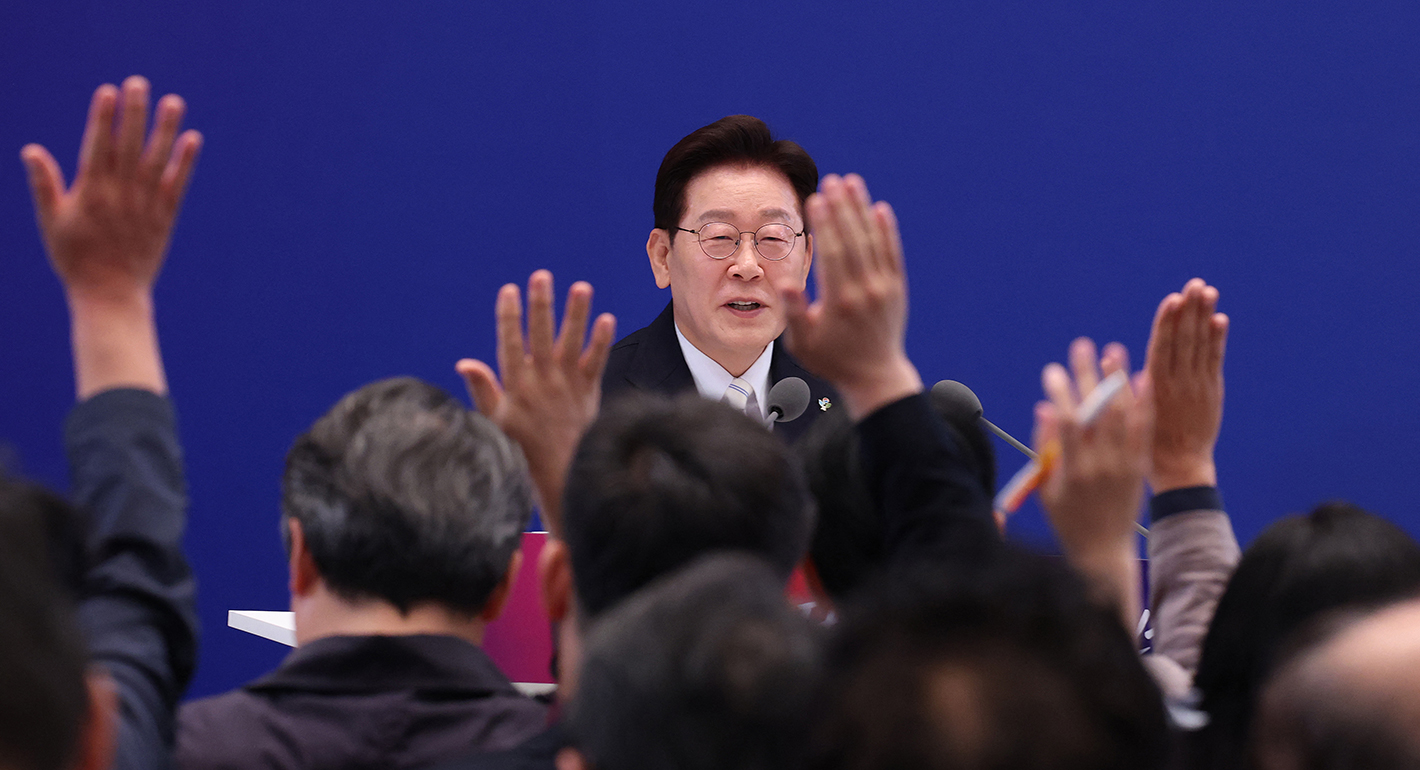
President Lee marked his first year in office after one of the most tumultuous periods in South Korean politics. Though Lee has enjoyed a high approval rating, a large majority in the National Assembly, and foreign policy victories, Lee and his party’s political fortunes depend on generating economic growth, learning the right lessons from the recent local elections, and managing contentious factional strife within his political base.
South Korean President Lee Jae Myung marked his first anniversary in office on June 4, 2026, after one of the most tumultuous periods in contemporary Korean politics. Preceding this moment, in 2022 Lee Jae Myung lost by the thinnest of margins (0.7 percent) to Yoon Seok Yeol, and it was virtually impossible to imagine that within two and a half years, Lee would come to power in Korea. Yet Yoon’s disastrous declaration of martial law in December 2024 that was annulled by the National Assembly within a few hours led to Yoon’s impeachment and later removal from office. Together with Yoon’s ignominious fall from power, President Lee and the Democratic Party (DP) in the spring of 2025 were at their peak since the DP already had a supermajority in the National Assembly after the April 2024 general election.
For most of his first year in power, Lee enjoyed an approval rating around low to mid 60 percent. But in mid-June 2026, following the local election and ongoing fallout from the ballot shortage crisis, Lee’s support dipped below 50 percent for the first time since becoming president in June 2025.1 Lee’s overall success since assuming power, however, is going to face crucial domestic and foreign policy challenges going into his second year and beyond. As the June 3, 2026, local election results showed, the Korean electorate gave Lee’s party a victory but one painted with caution on all sides to ensure that neither Lee nor his party can continue to flex their immense political muscle without checks and balances.
Lee’s first year in office was marked by three major developments. As expected, Lee continued to stress that his government was going to root out all remnants of those who directly or indirectly supported or were involved in declaring martial law. Indeed, if Yoon didn’t self-destruct by declaring martial law in December 2024 it is impossible to imagine that Lee would be president today. But Lee has quickly established himself and is dominating politics and foreign policy while backed up by a huge DP majority in the National Assembly. On the opposite side of the aisle, Lee faces a totally discredited opposition party still in the throes of pro- and anti-Yoon factional strife, but this is not going to help Lee as he addresses far more pressing economic and cost-of-living issues.
On the economic front, Lee is simultaneously wearing two hats. As U.S. President Donald Trump’s tariff wars began in earnest in the spring of 2025, Lee’s first priority was to reach a tariff agreement with the United States. In July 2025, Seoul concluded a trade agreement that included South Korea’s pledge to invest $350 billion in the United States, but Trump said in January 2026 that he would raise tariffs if South Korea didn’t expeditiously enact the trade deal.2 Lee also stressed the importance of corralling South Korea’s global tech and manufacturing giants such as Hanwha, Hyundai Motor Group, LG, Samsung, and SK Hynix. But at the same time, the DP pushed through the so-called Yellow Envelope Act in August 2025 that expanded the reach of labor unions by including non-employee members and justifications for lawful industrial action. The bill was boycotted by the conservative opposition People Power Party (PPP), and the business community was uniformly against the act that came into force in spring 2026.3
But it was in the foreign policy arena where Lee was, arguably, most successful. As soon as he entered office, he signaled his desire to continue the strengthening of Korean-Japanese ties that began under Yoon. As long-time Korea observer Dan Sneider wrote in January 2026, Lee’s pragmatic approach to national security affairs was a pleasant surprise to his detractors and an unwelcome turn for his core supporters.
“Lee made significant concessions on trade and investment issues in talks with the Trump administration to preserve the security alliance, though he can claim to have won a better bargain than Japan on both fronts. South Korean negotiators pushed the timetable for the long-sought transfer of wartime operational control of armed forces and made a deal to construct nuclear-powered submarines that could lead to a revision of restrictions on nuclear fuel enrichment and reprocessing. But even within the Lee administration, there is unhappiness over a shift in the focus of US military presence towards contingencies for confrontation with China.4”
Lee first met with Japanese Prime Minister Takaichi Sanae in October 2025 during the APEC meeting in Gyeongju, South Korea, but contrary to initial expectations that a very conservative Japanese prime minister and a liberal South Korean president wouldn’t get along, the two leaders have strengthened bilateral ties. After assuming office, Lee argued that foreign policy should be based on hard-nosed pragmatism. And for the first time, a South Korean president visited Tokyo enroute to Washington, DC. In January 2026, Takaichi and Lee met in her hometown in Nara, Japan, and she reciprocated by visiting Lee’s hometown in Andong, South Korea, in May 2026. As a New York Times article emphasized in May 2026, “within South Korea, and within Mr. Lee’s own Democratic Party, voices have grown in recent years calling for closer cooperation between Seoul and Tokyo to address global supply chain disruptions and deepening geopolitical uncertainty, including the rapidly shifting foreign policy of the Trump administration.”5
Although Lee continued to emphasize engagement with North Korea and strengthening peaceful coexistence, North Korea’s Kim Jong Un has refused, so far, to work with Lee. Moreover, even after North Korea announced an “adversarial two-state policy” in December 2023, senior officials in Lee’s government such as Minister of Unification Jeong Dong-young crafted a policy referred to as “peaceful two-state relationship oriented towards unification.” This stance drew instant criticism on two fronts: “that it violates Article 3 of the South Korean Constitution, which asserts sovereignty over the entire peninsula and enshrines the obligation to pursue peaceful unification; and that it reflects an excessive preoccupation with achieving inter-Korean rapprochement at the expense of a clear-eyed reading of North Korean intentions.”6
North Korean leader Kim Jong Un not only found new near-term political and financial support from Russia when he began to send North Korean soldiers to fight alongside Russian forces against Ukraine in 2024, Kim also received new security support from Moscow that enabled Kim to reduce his overarching dependence on China. Pyongyang and Moscow are negotiating a new defense cooperation agreement that is going to run until 2031.7 Not unlike his grandfather, Kim Il Sung, who adroitly maximized returns from both the former Soviet Union and China, Kim has been able to strengthen his leverage with both Moscow and Beijing. When Chinese President Xi Jinping visited North Korea from June 8 to 9, 2026—his first visit to Pyongyang in seven years—China Central Television reported that Kim stated that North Korea’s ties with China were one of “unchanging strategic choice.”8
Pyongyang’s close ties with Russia and China means that there is only limited utility in pursuing talks with Seoul as was the case under the Moon Jae-in administration that was totally consumed by prioritizing breakthroughs with North Korea. But if Trump turns his attention to reaching a nuclear deal with Kim—something that he was consumed with in his first term but never realized—it’s not impossible to imagine a U.S. president landing in Pyongyang for the first time to showcase his negotiating prowess. As soon as he re-entered the White House in January 2025, Trump said that Kim “is a nuclear power . . . [and] I think he’ll be happy to see I’m coming back.”9 In October 2025 when he travelled to Asia, Trump hinted that he would be open to meeting with Kim and repeated that he “had a great relationship” with the North Korean leader.10
While Seoul and Washington remain committed to the “complete denuclearization” of North Korea, the coming clash is between the assessment of the International Atomic Energy Agency that says North Korea is pursuing a “very serious increase” in its nuclear weapons capabilities,11 and Trump’s desire for a diplomatic win over one of the most intractable nuclear quagmires. Given his penchant for the limelight and his version of out-of-the-box foreign policy victories, Trump is very likely to focus his attention on Kim to demonstrate why only he can deal with North Korea and other U.S. adversaries such as Venezuela and Iran.
If Trump flies to Pyongyang and announces that the North Korean problem has been “totally resolved” by declaring some type of nuclear freeze in exchange for sanctions relief and a roadmap toward normalizing U.S.–North Korea ties, Lee will likely welcome such an agreement. Even though Lee has stressed pragmatic foreign policy strategies such as a three-step roadmap including a nuclear freeze, arms reduction, and denuclearization talks, this process is going to face uphill struggles since Kim has stated unequivocally that he will never give up his nuclear arsenal. In September 2025, Lee said that he would be willing to accept a freeze in North Korea’s nuclear program as an “interim emergency measure” and stated in an interview that “the question is whether we persist with fruitless attempts to achieve our ultimate goal [of denuclearization], or we set more realistic goals and achieve some of them.”12
For the South Korean left, a “breakthrough” in inter-Korean relations by way of a Trump-Kim nuclear deal would be most welcome, especially because Kim has repeatedly stated that he has no desire to engage with Seoul because he considers South Korea to be North Korea’s archenemy.13 Although the Lee administration would support a Trump-Kim nuclear agreement, such a deal may be more harmful for South Korean (and Japanese) security down the road since Kim has said explicitly that he has no intention of negotiating away his nuclear and missile programs. In September 2025, Kim stated in a speech before the Supreme People’s Assembly that “If the U.S. drops its hollow obsession with denuclearization and wants to pursue peaceful coexistence with North Korea based on the recognition of reality, there is no reason for us not to sit down with the U.S.”14
As Trump has demonstrated throughout his presidency, so long as he can tout his “unprecedented” foreign policy achievements, it matters little if key allies suffer security consequences such as weakened extended deterrence against North Korea’s growing nuclear arsenal including nuclear-tipped submarine-launched ballistic missiles.15 While a U.S.–North Korea nuclear deal will pose challenges for the Lee administration, in the end, Lee will support such an agreement to satisfy Trump, bolster his own standing among his progressive supporters, and amplify his core national security goals.
Lee’s signature defense policy since taking office can be boiled down to two major agendas: securing U.S. support for South Korea to build its first nuclear-powered submarine (SSN) and full reversion of OPCON or operational control to the Republic of Korea (ROK) during Lee’s term or before May 2030.16 Under the U.S.-ROK Combined Forces Command (CFC) structure that remains the primary structure for bilateral military cooperation, including the stationing of some 28,000 U.S. Forces Korea (USFK), a U.S. four-star general retains wartime OPCON, although it functions under a binational command led by both presidents of the ROK and the United States. As a symbol of growing self-reliance and national sovereignty, peacetime OPCON was transferred to South Korea in the early 1990s. But both U.S. and ROK armed forces argued that wartime OPCON transfer could only be executed if key conditions were met, such as strengthening South Korea’s ISR (intelligence, surveillance, and reconnaissance) capabilities.
Although there are those who continue to maintain that full OPCON transfer to South Korea will weaken the alliance and military preparedness, many argue that it is time that South Korea had full control over its own military forces. As one South Korean military analyst emphasized, “OPCON transfer is how the alliance completes its transformation from the asymmetric partnership of the Korean War era into the strongest and most mature global comprehensive strategic alliance the twenty-first century demands. That foundation already exists. What remains is the political will—and the momentum—to complete what both sides have already begun.”17 U.S. Secretary of Defense Pete Hegseth stated at the 2026 Shangri-la Dialogue in Singapore on May 30, 2026, that it was important to find an optimal balance and stressed that “as we phase over to wartime OPCON transfer for the Republic of Korea, which we welcome the fact that they want that” and also emphasized that “President Lee’s decision to increase defense spending to the new global standard of 3.5 percent (of the gross domestic product) and to assume greater responsibility for its conventional defense reflects simply a clear-eyed understanding of the threat environment.”18
Along with OPCON transfer, and as noted above, the Lee administration has also pursued one of the Korean military’s (and in particular, the ROK Navy’s) long-time desire to build a nuclear-powered submarine. In October 2025, when Lee asked Trump’s approval to help shift South Korea toward nuclear-powered submarines to enhance deterrence missions with the United States, Trump gave his initial support.19 On May 26, 2026, during the inaugural meeting of the Future Defense Strategy Committee, Lee re-emphasized the crucial importance of a nuclear-powered submarine program. Minister of Defense Ahn Gyu-back stressed that,
“The nuclear-powered submarines Korea plans to acquire will be conventionally armed and unrelated to strategic nuclear submarines carrying nuclear weapons [and] Korea will firmly comply with the international nuclear nonproliferation regime while continuing cooperation with the International Atomic Energy Agency.20”
As expected, the reaction from China was extremely negative. The Japan Times reported in June 2026 that “Chinese strategists will see a future fleet of nuclear-powered attack submarines—operated by a U.S. treaty ally—possessing the endurance, stealth and operational reach to pierce deep into regional waters and strategic chokepoints for extended periods.”21 Chinese analysts have uniformly criticized the U.S.-ROK SSN deal and emphasized that on top of the AUKUS (Australia-UK-U.S.) SSN program, “Japan is also hyping its plan to own nuclear-powered submarines, and an arms race over nuclear-power submarines could break out.”22 Nonetheless, the fact that America’s allies are enhancing submarine capabilities, including SSNs, attests to their growing uncertainty about China’s own rapid naval power projection capabilities throughout the Western Pacific, with the goal of directly contesting U.S. naval supremacy in the region.
If Lee’s major consolations came from foreign policy successes in his first year coupled with a very discredited opposition party, the results of the June 3, 2026, local elections were a sharp reminder that political power and influence never lasts forever. A total of sixteen gubernatorial and mayoral seats were up for grabs and fourteen National Assembly by-elections on June 3, in addition to numerous city and district council elections. Overall, the ruling DP won twelve gubernatorial and mayoral races and grabbed nine of fourteen National Assembly seats—a clear-cut victory, but Korean voters sent a blunt message to the ruling progressives and tarnished conservatives. Lee’s DP was banking on expunging the PPP from the political map by equating the PPP with Yoon’s political 2024 coup or the party of far-right ideologues. But while the DP won more gubernatorial and mayoral races, the voters didn’t give Lee carte blanche—a warning that too much power in the hands of one party can be dangerous.
The conservative opposition People Power Party did better than expected by winning the all-important mayorship of Seoul.23 Mayor Oh Se-hoon won a stunning victory that defied surveys suggesting Oh was destined to lose. But Oh won a historic fifth term as Seoul mayor with 49.22 percent of the vote versus Cheong Won-oh, who mustered 48.07 percent. In an ongoing controversy that will continue to haunt the Lee government, some ninety polling stations ran out of voting ballots nationwide, including fourteen stations in the southern part of Seoul, a traditional stronghold for the PPP, that resulted in delays and furious citizens who couldn’t exercise their vote.24 This has never happened before and while the head of the National Election Commission resigned to take responsibility and the government promised a thorough investigation, it fueled controversy over concerns that certain aspects of the election could have been tampered with. It was the type of news that the Lee government didn’t want to hear as it was celebrating Lee’s first year in power.25 While Oh faces legal challenges unrelated to the race—as does Lee from previous legal cases before he assumed the presidency, although his party has pushed a bill to cancel all previous indictments against Lee—the voters’ main message to the conservatives was to signal the need for the party to rid itself of far-right extremists and to fundamentally reform the party.
On top of Oh’s victory, a minor political earthquake occurred with the by-election victory of independent candidate and former head of the PPP, Han Dong-hoon. Han served as Yoon’s first minister of justice but was pushed aside when he argued that Yoon’s wife, Kim Kun-hee, should address corruption charges. (She is currently in jail awaiting a final rendering by the Supreme Court of Korea.) When the PPP suffered a humiliating defeat at the last National Assembly election in April 2024 that gave the DP a near two-thirds majority, Han was chosen as the PPP head. But die-hard Yoon supporters never forgave Han for instantly opposing Yoon’s short-lived martial law fiasco and the pro-Yoon faction ousted Han from the party. Han’s resurrection by winning a by-election in a district in Busan, South Korea’s second largest city and biggest port, that was formerly held by a member of the DP, not only means that he is going to emerge as the strongest leader in the PPP, but also a formidable candidate for president in 2030. When asked about his future plans, Han stated, in part, “The words and actions of the current party leadership camp do not match the dignity or competence the conservative party has carried, [and] we must now reflect on those aspects and set the right course. I think many people agree on that point.”26
While it will take weeks and months before the dust settles with significant realignments in the party leaderships in both the DP and the PPP, the June local elections illustrated three new aspects of Korean politics.
First, the traditional left-right divide on major domestic and foreign policy issues such as sentiments toward big businesses, taxing the rich, optimal approaches to North Korea, and critical relations with the United States and China remain, but not nearly as strongly as a decade ago. Indeed, one of Lee’s biggest dilemmas is how to manage the growing tension within his broader ruling coalition between pragmatists who stress national interests over ideologies, and die-hard progressives who are deeply disappointed with Lee’s penchant for pragmatism despite his charismatic leadership that brought the DP back to power with a huge majority in the National Assembly.
Second, the makeup of the Korean electorate is fundamentally different due to generational shifts, massive demographic shifts, and divergent policy preferences. In 2026, for example, 21.6 percent of South Korea’s 51 million people were over the age of sixty-five; that makes the country one of the fastest super-aging societies in the world with only 9.7 percent of the population between the ages of zero and fourteen.27 There is also a sharp divide among male and female voters in their twenties. For example, in the June 2026 local election, 55.8 percent of males in their twenties voted for the conservative PPP, while only 33 percent opted for the progressive DP; 66.4 percent of female voters chose the DP and only 25.7 percent voted for the PPP.28
And third, coupled with South Korea’s anemic economic growth rate as a mature advanced economy, one of the major reasons Korea’s 2030 generation did not vote for the progressives en masse compared to the 1990s and 2000s is the growing wealth gap between Koreans in their twenties/thirties and forties/fifties. According to 2025 data, the value of real estate held by those in their forties was 2.6 times higher than those of the 2030 generation while the real estate value of those in their fifties was 2.8 times higher than people in their twenties and thirties.29 For those in their twenties and thirties, it is becoming increasingly difficult to finance their own apartments with constantly rising real estate prices, becoming a major factor behind delaying marriages and the country’s imploding birth rate. This doesn’t mean, however, that the 2030 generation is going to pivot strongly to the conservatives given the PPP’s inability to really connect with younger voters.
For Lee, the most important task over the next two years is to ensure that the DP retains their supermajority in the National Assembly after the April 2028 general election. If that happens, it will ensure that he will be able to exercise significant influence going into the May 2030 presidential election and have sway on who will be his successor. Currently, the DP has 161 seats versus 110 for the conservative PPP followed by eighteen minor parties that are aligned ideologically with the DP, three seats linked more closely with the PPP, and eight independents. Overall, the DP has a very comfortable majority of 179 seats out of a total of 300.30 The DP has long dreamed of gaining a two-thirds majority or a total of 225 seats that would enable them to push through constitutional amendments to allow a sitting president to run for a second term although each term could be reduced to four years rather than five. For the PPP, ensuring that the DP and its allies never reach a two-thirds majority lies at the heart of their political battle that will stretch into the final days of the April 2028 campaign.
Thus, domestic politics, and specifically, Lee’s ability to continue to control the DP and to put the PPP off-guard is going to remain at the top of his agenda. More immediately, Lee wants to see his preferred candidate head the DP, such as former prime minister Kim Min-seok, who stepped down in early June 2026 to run for the party presidency.31 This is because the next party head will oversee the all-important 2028 general election that will pave the way, both good and bad, for the DP heading into the 2030 presidential election. For the next two years, Lee will continue to exercise an iron grip over the DP and the broader ruling coalition, but unless he is able to bring significant housing price relief to middle income and especially younger Koreans in their twenties and thirties, he will face major blowback.
Lee’s biggest challenge, however, is much more systemic since he must increase social-welfare spending and defense spending (pushed by Trump) while the economy grows between 1 and 2 percent. Moreover, as South Korea’s demographic shift accelerates as a super aging society (20 percent or more of the population is over sixty-five), South Korea uses more industrial robots per worker than in any other country worldwide, or 122 per 1,000.32 This, in turn, has led to growing tensions with leading labor unions. The most positive social development that has occurred over the past several years is South Korea’s unexpectedly slowly rising birthrate. In 2025, its birthrate rose to 0.80 from 0.75 in 2024 based on a post-pandemic boost and government policies to provide a wide range of incentives to have children.33 If current trends continue, the total fertility rate could break above 1.0 in 2031.34
In short, if Lee wants to go down as a successful president in the midst of worsening external economic, security, and energy environments, he cannot afford to govern on the basis of old playbooks such as placating the leftist base of his ruling coalition: strong pro-labor policies and a pro-engagement tilt on inter-Korean relations. Thus far, Lee has shown his ability to make pragmatic choices instead of adhering to ideology, but he is going to face an uphill battle to ensure that the DP remains in power even after the April 2028 National Assembly election. No previous progressive leader has faced such a large swath of crucial external challenges, outstanding legal issues stemming from his political life before becoming president, and at the same time, showcasing South Korea’s growing global leverage as a high-tech giant and a country eager to assume greater self-reliance on defense. In the end, Lee’s continued political success depends on his sustained ability to pivot to the center while pushing down die-hard ideologues in his own government and the DP.
Senior Fellow, Asia Program
Chung Min Lee is a senior fellow in Carnegie’s Asia Program. He is an expert on Korean and Northeast Asian security, defense, intelligence, and crisis management.
Recent Work
Chung Min Lee
Carnegie does not take institutional positions on public policy issues; the views represented herein are those of the author(s) and do not necessarily reflect the views of Carnegie, its staff, or its trustees.

Carnegie experts recommend the books that kept them turning pages—and learning along the way.


Sophia Besch, Eric Ciaramella, Steve Feldstein, …

Over the past ten years, NATO has held almost as many summits as it did during the entirety of the Cold War. Are they still useful, or is it time to stop holding annual meetings?

Rym Momtaz, ed.
The move is an escalation of its war on multilateralism.

Stewart Patrick

As the EU confronts profound challenges, several leaders have called for fundamental reform to the union’s model—but only modest, superficial changes have resulted. What if Europe really could be reimagined from zero today: What should such a redesigned European order look like?

Richard Youngs, ed.
Nearly a year and a half after Europeans leaned into sucking up to Trump, the strategy has produced some benefits when it comes to Ukraine.
Rym Momtaz