

Commentary
The war does threaten Putin’s existence. That is why he does not negotiate.
René Nyberg
{
  "authors": [
    "Alexander Kolyandr",
    "Alexandra Prokopenko"
  ],
  "type": "commentary",
  "blog": "Carnegie Politika",
  "centerAffiliationAll": "",
  "centers": [
    "Carnegie Endowment for International Peace",
    "Carnegie Russia Eurasia Center"
  ],
  "englishNewsletterAll": "",
  "nonEnglishNewsletterAll": "",
  "primaryCenter": "Carnegie Russia Eurasia Center",
  "programAffiliation": "",
  "regions": [
    "Russia"
  ],
  "topics": [
    "Economy",
    "Domestic Politics"
  ]
}
Source: Getty
Russia’s banking sector is sinking ever deeper into a crisis that the authorities are simply managing rather than trying to fix.
On October 23, Russia’s central bank left the key interest rate unchanged at 14 percent for the second time in less than two months, while also acknowledging that it would be higher in 2027 than it had previously forecast: 12.5–13.5 percent on average, instead of 10.5–12.5 percent. At a press conference that same day, central bank chair Elvira Nabiullina said that there were no risks to financial stability right now, difficulties repaying debts were “only being experienced by individual highly leveraged companies,” banks “are undergoing restructuring where necessary,” and the central bank “does not expect banks to announce losses en masse.”
Each of these statements is accurate, but rather than a lack of problems, they describe how a problem is being managed. Restructuring makes it possible to avoid announcing losses, the “individual companies” represent 11.7 trillion rubles in loans that the central bank itself considers to be problem loans, and the whole structure is threatened by the stubbornly high key rate.
The situation is something of a paradox. On the one hand, Russian banks are posting record profits (3.5 trillion rubles in 2025 and up to 4.4 trillion rubles in 2026, according to central bank forecasts). Customers are not withdrawing their funds, and banking licenses are not being revoked. On the other hand, the economy is deteriorating. GDP grew by just 0.6 percent in the first half of this year, the central bank’s Business Climate Index remained in negative figures all summer, businesses are complaining of missed payments, and the state is borrowing more and more.
The explanation for this apparent contradiction is tripartite. First, the record profits announced by Russian banks come not from economic growth, but from the budget. Second, some of that profit only exists on paper, because losses are only acknowledged gradually. Third, the speed of that acknowledgement has become a tool that the state uses to manage the banking system, and to conceal the unfolding crisis. The question is how long it can continue to do so.
There are several channels through which Russian banks make money from the budget. The first is government borrowing. In 2026, the state will spend 7.3 trillion rubles more than it will receive: twice the amount planned, and equivalent to 3.2 percent of GDP. The shortfall will be made up for by borrowing, and the main creditors are banks, which already hold about 19 trillion rubles in government bonds on their balance sheets. A significant part of that sum is held in so-called floater bonds, for which the return is tied to the central bank base rate. At rates of 14 percent, this is the most reliable kind of income from interest in the country.
The second channel is through subsidized mortgage rates. The budget reimburses banks the difference between subsidized rates for certain borrowers and market rates. This year, between half and two thirds of all mortgages issued fell under these programs. It’s no surprise that Nabiullina is calling for them to be curtailed.
The third channel, similarly, consists of compensation paid to banks in exchange for issuing loans at preferential rates to companies working in industry, agriculture, export, and defense.
The flip side of this dependency on the budget is that banks are increasingly unwilling to issue loans to entities that do not have government backing. Lending to small and medium-sized civilian businesses decreased in July by 5.5 percent year on year.
That’s not to say that everything is fine in the banking sector. Problem debts owed by companies identified as such by the regulator (because the company is in difficulty, or the loan has been restructured or is being repaid with difficulty) had reached 13.3 trillion rubles by September 1, or 12.9 percent of the country’s corporate loan portfolio. Missed payments, however, only accounted for 3.5 percent of the portfolio, at about 3.7 trillion rubles.
There will always be more problem debts than missed payments: The former is an assessment that payment will not be made on time, while the latter is an established fact. The difference is that although the regulator has recorded the deterioration of problem loans, it does not require the bank to allocate reserves to cover them so that there is no capital shortfall if the loan has to be written off. Under Russian accountancy rules, reserves are only created for this purpose once payments are actually missed, which subsequently reduces the bank’s profit.
A reduction in the profit of Russian banks due to loans being reclassified from “problem” to overdue is highly likely. More than half of problem loans are currently unsecured. These 7.2 trillion rubles, by the central bank’s own estimates, account for about 70 percent of the capital that banks hold above the mandatory minimum, and more than the sector’s annual profit, even if profit is assumed to be in the upper range of the latest forecast.
So why is this not reflected in the financial statements? Three mechanisms are at play here. The first is restructuring. Under Russian regulations, banks are obliged to set aside reserves when a borrower is late making a repayment. But if the debt is restructured to have a new repayment schedule, the late payment is disregarded and there is no need to increase reserves.
Since May 2025, the central bank has allowed banks not to increase their reserves when restructuring loans—so long as the company that took out the loan presents a “realistic” business plan. Those plans are largely based on the government’s official macroeconomic forecasts. In other words, the more optimistic expectations are at the top, the less the bank is obliged to set aside in reserves.
In July, Russian banks’ spending on corporate loan loss reserves fell by 77 percent, which was reflected in their profits. New repayment schedules and rosy official forecasts are enabling banks to generate a profit essentially based on government documents.
The second mechanism is the capitalization of interest: when interest on a loan is simply added to the loan amount, and the bank records it as an asset. Interest that has accrued but not been received on corporate loans has risen by a third so far this year, to 4.6 trillion rubles.
The third and final mechanism is by calculating government bonds at their purchase price rather than their market value. As a result of this practice of revaluing bonds, Russian banks have undisclosed losses of 0.6 trillion rubles.
The regulator itself makes no secret of these mechanisms. In its reports, it says portfolios of bad loans “will mature gradually, and banks will be able to cover their losses using their profits.” In other words, the current record profits are officially described as a fund for future write-offs.
Another source of banks’ record profits is also linked to government debt. In September, after a two-month hiatus due to a lack of demand, the Finance Ministry issued 1.4 trillion ($17 billion) in government bonds: the largest monthly amount since the start of the year. Some 72 percent of the bonds were floater bonds.
Russian banks purchased 77 percent of the bonds on offer. In the same month, borrowing from the central bank was up 1.7 trillion rubles ($21 billion)—almost entirely through repo transactions, short-term loans collateralized by securities. The banking sector’s debt to the regulator jumped from 6.7 trillion rubles ($83 billion) to 8.4 trillion rubles ($104 billion) in the space of a month. Meanwhile, the government’s funds held in bank accounts increased by 900 billion rubles ($11 billion). In effect, the money raised by the finance ministry was then parked in treasury accounts at those same banks.
Despite appearances, this is not the same as printing money. When the government spends what it borrowed, the money will return to the banks and repo transactions will be settled. The result is a triangle. The federal budget borrows from banks, the banks borrow from the central bank to buy government securities, and the central bank transfers three quarters of its profit back to the budget.
The budget can’t issue debt without the banks, the banks won’t buy that debt without the central bank, and the central bank can’t turn them down without obstructing the financing of the deficit. Economists call this situation fiscal dominance: when the government’s budget deficit starts to determine central bank policy. Under the draft budget for 2027–2029, the deficit is forecast to be about 5 trillion rubles per year, and by 2028, it will be almost equal to interest payments due on accumulated debts.
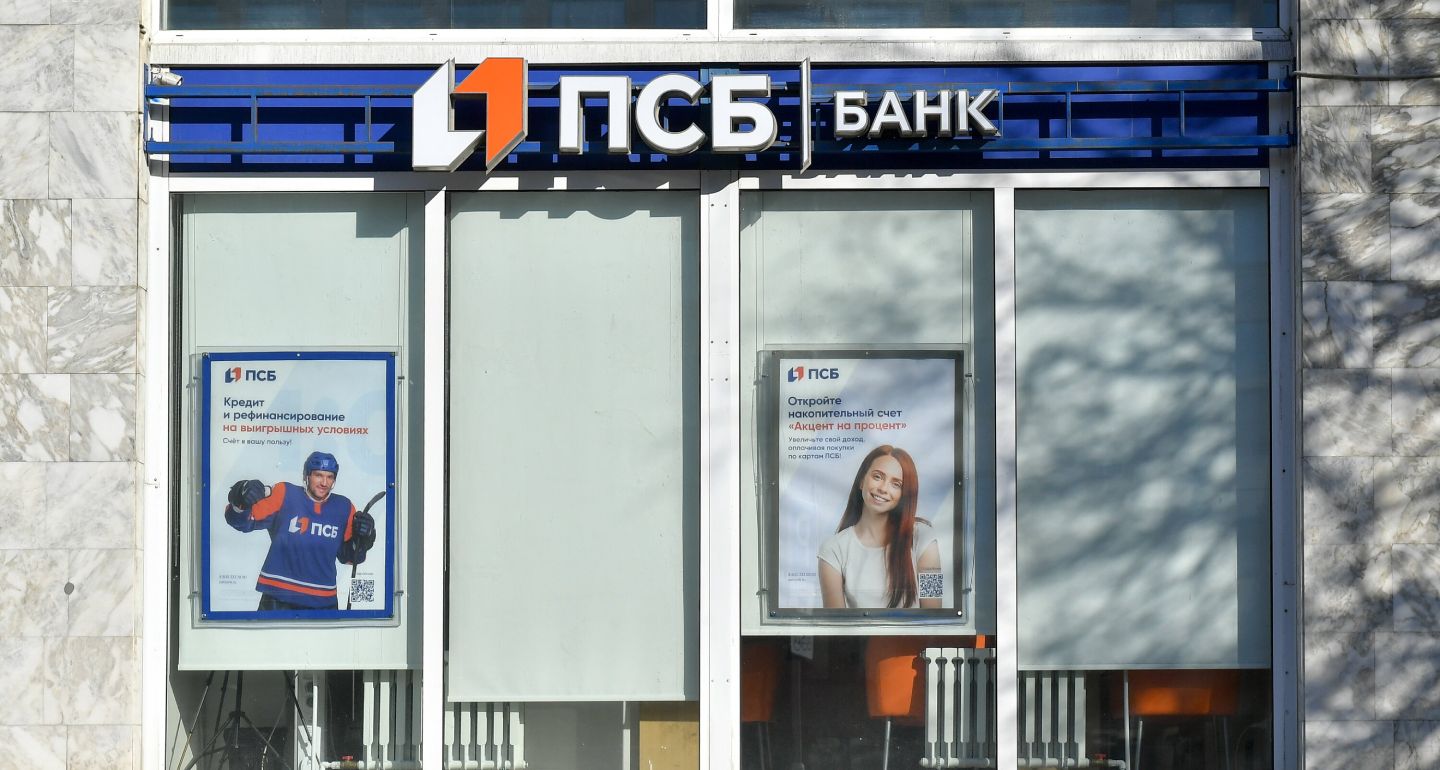
A case apart is Promsvyazbank (PSB): since 2018 the main authorized bank for state defense orders, which, in the words of its chief executive Pyotr Fradkov, is focused above all on “supporting the defense-industrial complex.” It cannot turn down a borrower assigned to it by the state, and the very model of defense procurement—cost plus a fixed margin—made credit more expensive than the permitted profit once the key rate reached 21 percent (“at this rate, any contract becomes loss-making,” Sergei Chemezov, CEO of the state defense conglomerate Rostec, complained in late 2024).
Add in the Defense Ministry’s payment delays, and an overdue PSB loan winds up as an unpaid ministry invoice in different packaging. The scale of what goes unrecognized shows up in the gap between two sets of accounts: For 2025, the bank reported a 33 billion ruble profit under Russian accounting standards and a 19 billion ruble loss under IFRS, which requires provisioning for expected, not just incurred, losses.
The treasury keeps topping up the bank’s capital: 18.4 billion rubles in 2024, 27.4 and 11.8 billion in 2025, and five tranches already in 2026, bringing its charter capital to 445.9 billion. The wording is the same every time: “to ensure compliance with the capital adequacy ratio in connection with the conclusion of loan agreements in the execution of presidential instructions.” Part of the December money went toward PSB taking over defense loans from other banks’ balance sheets: It is a “bad bank” that nobody labels as such.
Reading this purely as a bank rescue is a mistake. Recapitalizing PSB is a way to expand military spending through the credit channel. A capital injection lets the bank lend more to the defense industry outside the military line of the budget, while the cost shows up in the treasury after the fact, in installments, and through the non-program line “Implementation of the functions of other federal government bodies,” under which 611, 555 and 753 billion rubles are reserved for 2027–2029 with no breakdown—three times this year’s figure.
This is not the “hidden war debt” referred to Craig Kennedy, a former investment banker now at Harvard University’s Davis Center for Russian and Eurasian studies: Every sum is published. It is a distribution of military spending across time and with varying degrees of visibility, which makes it hard to add up. One important caveat is that PSB is neither a model of the sector nor a leading indicator for it; judging Russian banks by PSB would be like judging the whole budget by the “National Defense” line. Something different is happening to the rest of the sector.
The entire structure rests on the premise that the key rate must decrease faster than losses accrue. A rate cut is expected by everyone: the banks, the budget, and companies that have taken on 20.8 trillion rubles of debt in floating-rate bonds.
The obstacle to cutting the key rate is inflation, for which the central bank has upped its forecast to 7.1–7.6 percent this year. The central bank’s decision will also determine who in Russia ends up paying for the losses that have accumulated in the system. If interest rates remain high, then it is borrowers who will have to foot the bill—through the creation of reserves, bankruptcy, and new injections of capital into state banks from the budget.
If the central bank decides to cut rates, regardless of inflation, the bill will be passed on to savers. Their 68 trillion rubles of savings will lose more in value than their owners receive in interest on them. In August, the amount of money kept in personal accounts decreased, though the central bank attributed this to seasonal spending on vacations and preparations for the new school year.
It’s not an easy decision, so the most likely scenario in coming months is that nothing will be decided. Instead, the problem will be postponed to next year, when the central bank head Nabiullina’s tenure is due to end.
Russian banks will likely manage to avoid panic among customers and the large-scale revoking of banking licenses. But that doesn’t change the fact that the sector is sinking ever deeper into a crisis that the authorities are simply managing rather than trying to fix.

Director, Eurasia Group

Senior Fellow, Carnegie Russia Eurasia Center
Alexandra Prokopenko is a senior fellow at the Carnegie Russia Eurasia Center.
Carnegie does not take institutional positions on public policy issues; the views represented herein are those of the author(s) and do not necessarily reflect the views of Carnegie, its staff, or its trustees.

The war does threaten Putin’s existence. That is why he does not negotiate.

René Nyberg
Russia’s coveted Red Sea naval base has fallen victim to its erratic foreign policy.

Sergey Konyashin
Mikhail Zvinchuk’s detention could have dealt a serious blow to Russia’s propaganda infrastructure in the Balkans. Instead, the incident has made something else eminently clear: Moscow values and protects its propagandists, while Europe still hasn’t figured out what to do with them.


Ivan Filippov, Ksenia Luchenko
Latvia and Lithuania have been considering whether they could temporarily host NATO nuclear weapons in the event of war or a similar crisis.

Sergejs Potapkins
Russia does not have to treat Western companies as equal partners. A centralized regime built on a foundation of oil and gas income was never going to relinquish what it saw as sovereign control.

Edward C. Chow